
Criminal Cases in Brazos County Courts
Brazos County felony filings normally belong to a Texas District Court. County Courts at Law Nos. 1 and 2 handle ordinary Class A and Class B misdemeanors. Yet the court name alone does not always reveal the offense level. Local allocation rules let a district court retain a misdemeanor connected to the same defendant's felony matter. Fine-only Class C charges and city ordinance cases remain with a municipal or justice court, whose docket is separate.
The Brazos County District Clerk is clerk for both district courts and county courts at law under Texas Government Code section 25.0232. That office maintains the filed pleadings, docket, judgment, sentence, and certified disposition. A police narrative or jail intake file remains with law enforcement, not the clerk. Cause numbers organize court files, while a booking number identifies one jail admission.
The official District Clerk page shows where the county's criminal case custodian works.
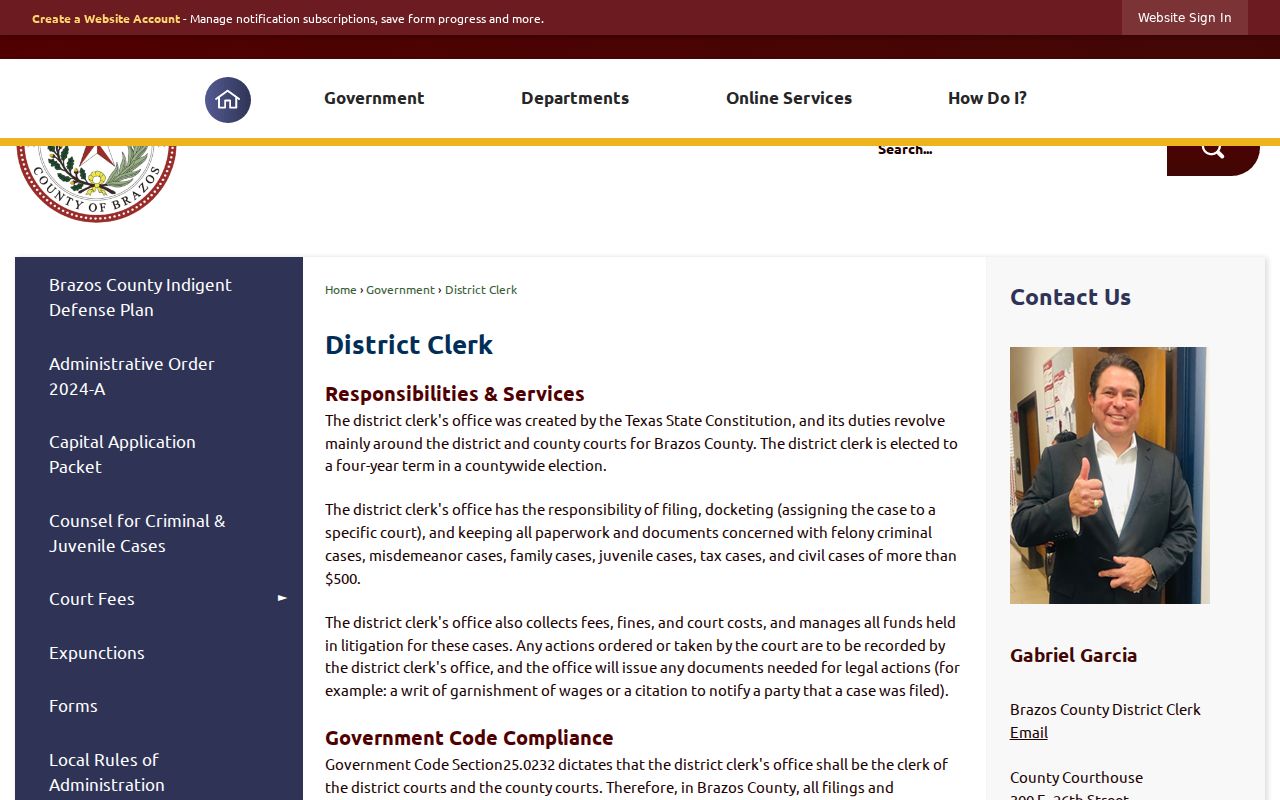
That contact route matters when an online case summary lacks the document needed to prove a disposition.
Brazos Felony and Misdemeanor Courts
Four named district courts appear in the county directory, although a county page still says “three” before listing four. The named list is the safer reference. The 85th, 272nd, and 361st District Courts hear felony matters and felony-connected misdemeanors. The 472nd, created in 2023, currently focuses mainly on civil, family, and juvenile work. County Courts at Law Nos. 1 and 2 hear the usual Class A and B misdemeanor docket.
The county's district-court jurisdiction page gives the local allocation context.
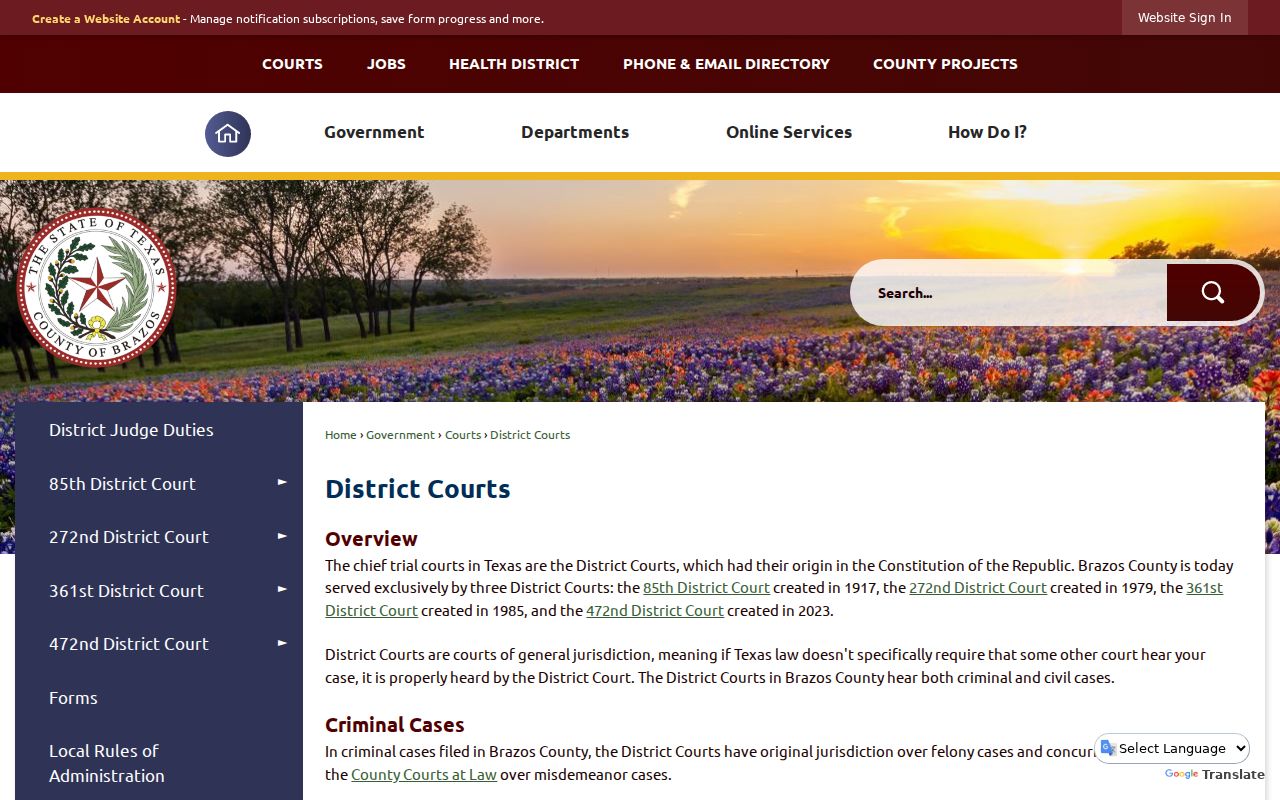
The image reinforces why searchers should confirm the assigned court rather than infer jurisdiction from a charge label alone.
The county-court page documents the two courts at law and their misdemeanor role.

Together, these official sources explain why the District Clerk spans both felony and higher-level misdemeanor case files.
Municipal and justice courts form a separate lower-court layer. They handle fine-only Class C and ordinance matters, so a search limited to the Tyler felony and misdemeanor docket can miss a city citation or JP case. Start with the issuing court when the paper names a municipal court or justice precinct. The College Station and Bryan municipal systems each maintain their own records, payment tools, and warrant processes.
How to Search Case Records
Begin with the official Brazos Tyler Judicial Records Search. Smart Search accepts a record or case number and a name in the displayed “Last, First Middle Suffix” convention. Search Hearings uses date ranges. JavaScript, cookies, and a supported browser are required. A full cause number is the best key because names can match more than one person.
- Open Smart Search and use the complete cause number when available.
- Otherwise enter the party name in the portal's stated order.
- Confirm the court, filing date, case type, and charge before accepting a same-name result.
- Read events, hearings, status, and disposition as separate fields.
- Order the entire case, final judgment, indictment, or another named item from the District Clerk when the summary is not enough.
| Field Label | Type | Required | Notes |
|---|---|---|---|
| Search Type | Tabs or menu | Yes | Smart Search or Search Hearings |
| Search Criteria | Text | Yes | Name or case number |
| Case Number | Text | Alternative | Use the full number when known |
| Date Filed | Date range | No | Narrows filed cases |
| Hearing Date | Date range | Hearings only | Narrows scheduled events |
| Court or Location | Dropdown | No | Options depend on the module |
The portal interface displays the county search route and its modules.
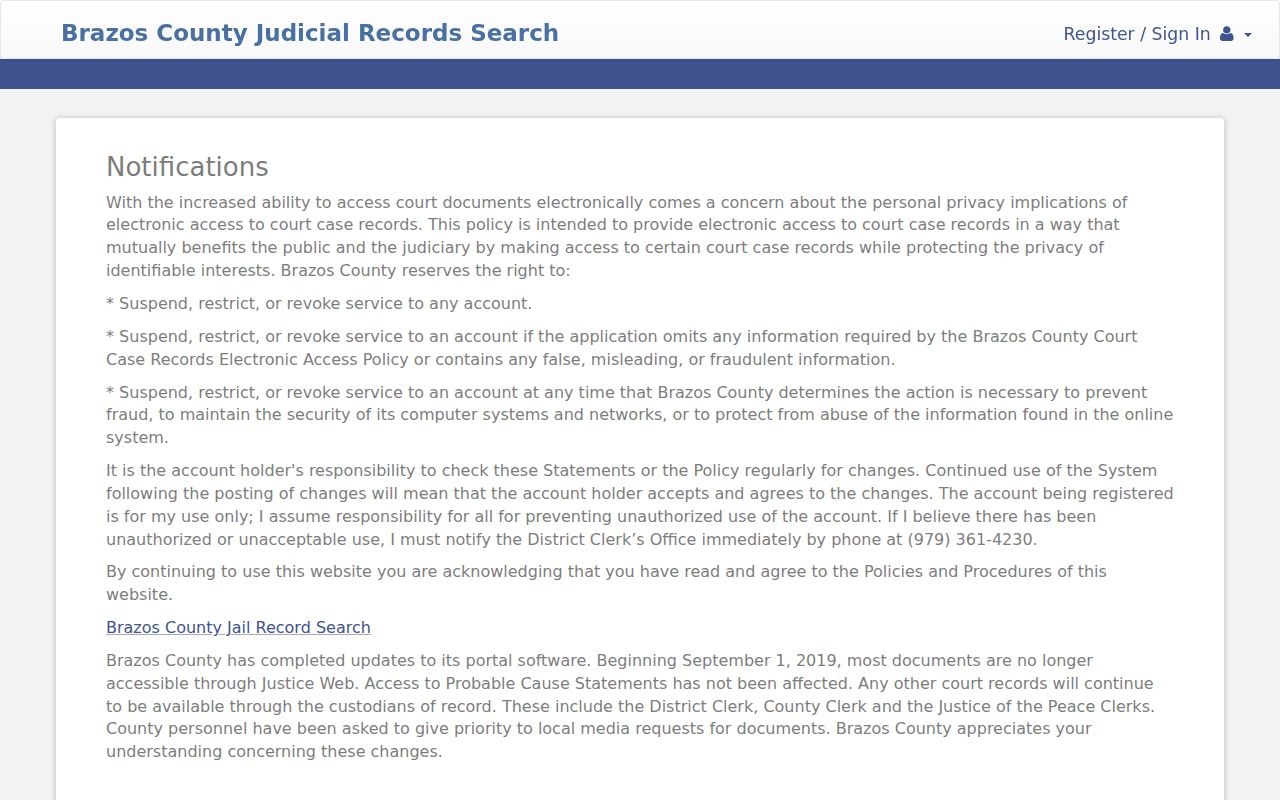
This public view is a locator and summary. A clerk-certified copy remains the authoritative court product.
Brazos Criminal Case Copies and Fees
The District Clerk's public-data form searches civil and criminal records from 1992 forward unless the requester narrows it. Supply the searched person's full name, date of birth if known, an approximate record date, aliases, or a cause number. Choose an entire case, final judgment, indictment, or other named document. Delivery choices are pickup, U.S. mail, or on-site inspection. Payment comes before evaluation.
| Clerk service | Current charge |
|---|---|
| Record search | $5 |
| Regular or electronic copy | $1 per page |
| Certification | $5 per document |
The official court-fee page controls over older county FAQs.
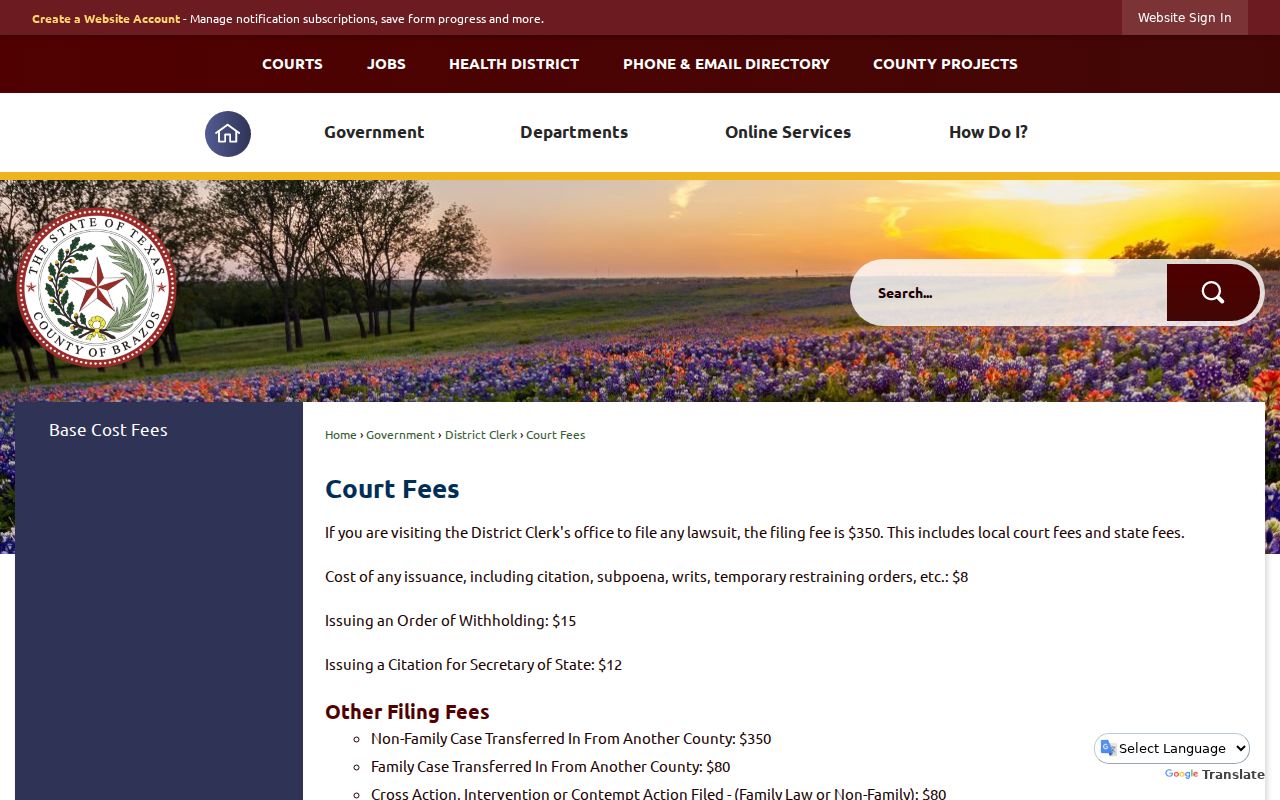
Ask for certification when the receiving office needs proof from the record custodian, not just a readable copy.
Requests can be sent to dcsearches@brazoscountytx.gov or delivered to Suites 1200/1201 at 300 E. 26th Street in Bryan. The counter accepts cash, while checks and money orders are also listed. Include a business-hours telephone and email so staff can clarify scope or cost. A broad name search can return both civil and criminal files, so a known cause number saves time and reduces the risk of ordering the wrong record.
Note: For a case before 1992, contact clerk staff because the standard form's default search range will not cover it.
Older Brazos Criminal Case Records
The standard District Clerk search form covers 1992 forward unless the request is narrowed. A case that predates that range may be archived, absent from the current electronic index, or available only with staff help. Give the clerk a full name, aliases, approximate year, offense, court, and any cause number found on old papers. Ask whether inspection or a copy request is the better route.
Do not assume a missing online result means no Brazos County case existed. The former Justice Web also changed after September 1, 2019, when most documents stopped being available there, although probable-cause statements were unaffected. The current Tyler summary, older index, and clerk-held paper or image file can have different coverage.
What the Case File Shows
A Brazos County criminal case file follows one cause number. It may contain the prosecutor's complaint, information, or indictment; motions and orders; court settings; a plea; judgment; sentence; costs; and the clerk's event history. These records answer different questions. The charging paper states the accusation, while the final judgment records the adjudicated result.
| Case Number & Court | Identifies the cause and the trial court assigned to it. |
|---|---|
| Charging Document | A complaint, misdemeanor information, or grand-jury indictment states the filed accusation. |
| Docket Entries | Chronological clerk entries show filings, orders, appearances, and settings. |
| Hearing Dates | Lists scheduled court events, which may change. |
| Disposition & Judgment | Records dismissal, acquittal, conviction, deferred adjudication, or another result. |
| Sentence & Conditions | Shows confinement, fine, costs, and community-supervision terms when ordered. |
Brazos Criminal Case Charging Documents
A complaint states alleged facts and can support the first court steps. An information is a prosecutor's formal charging instrument often used for a misdemeanor. An indictment is a grand jury's felony charging instrument. A no-bill means the grand jury declined to indict. None of these terms alone establishes guilt.
- Disposition
- The recorded outcome of a charge or case.
- Deferred adjudication
- Supervision imposed while the court postpones a finding of guilt; it is not a final conviction.
- Acquittal
- A not-guilty result after trial.
- Dismissal
- The charge ended without a conviction, subject to the order's exact terms.
A portal status such as “disposed” means the court has concluded that matter. It does not tell the reader whether the result was conviction, dismissal, acquittal, or deferred adjudication. Open the disposition and final judgment before drawing a conclusion.
For a DPS history that appears incomplete, obtain a certified Brazos disposition tied to the correct cause number and arrest event. Texas reporting links an arrest transaction to prosecutor and court updates. A missing tracking match can leave the state entry incomplete even when the local judgment is correct. The clerk cannot alter DPS data, but its certified record supplies the source document needed for an identity-linked personal review and dispute.
Stages of a Criminal Case
After an arrest, Texas requires magistration without needless delay and generally within 48 hours. Magistration supplies warnings, a probable-cause review, an appointed-counsel inquiry, and bond conditions. The prosecutor may then file an information or present a felony matter to a grand jury. Arraignment identifies the charge and plea. Pretrial filings address evidence, procedure, and possible resolution. A plea or trial leads to disposition, followed by sentencing when required.
Case flow: Charges Filed › Arraignment › Pretrial › Plea or Trial › Disposition › Sentencing
The Brazos County docket page links the named trial, associate, and justice courts.
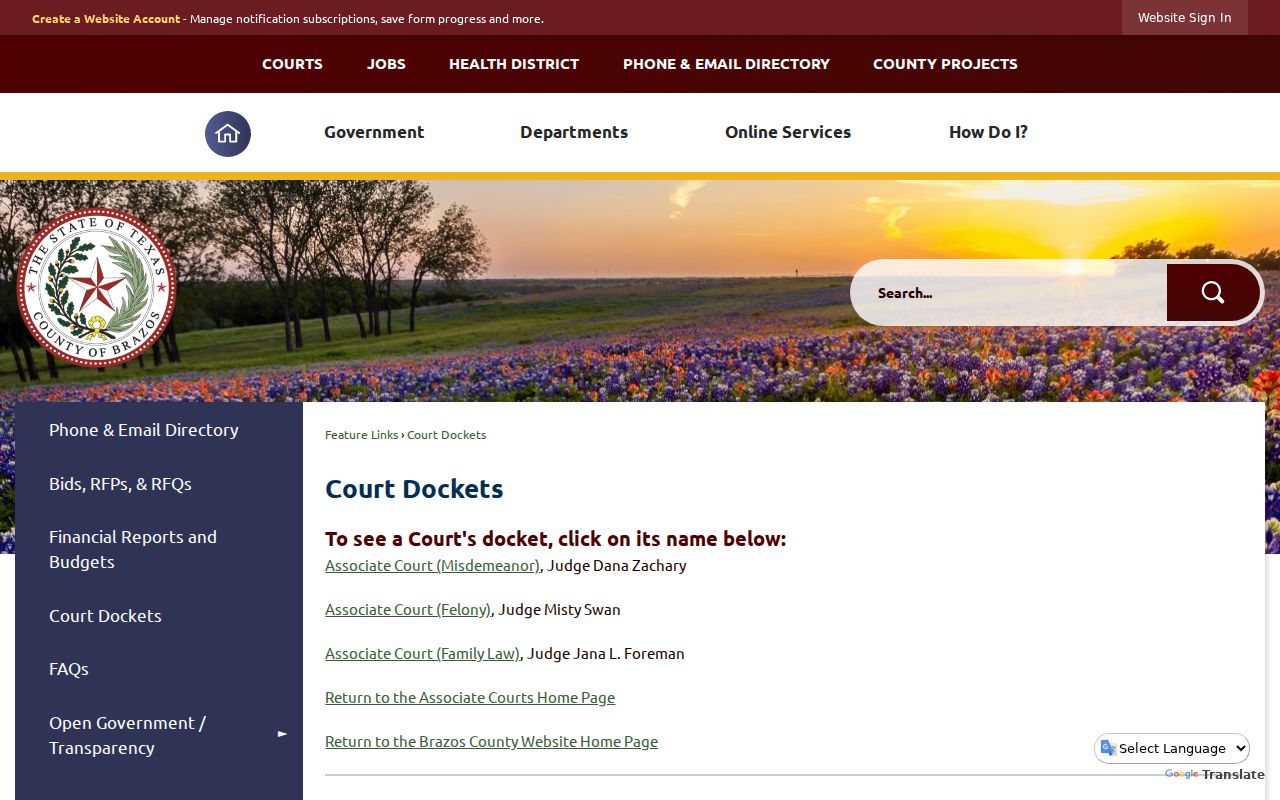
Posted dockets are snapshots and may change after publication, so confirm a live setting with the assigned court.
Brazos Criminal Case Dockets Can Change
County docket pages are posted as snapshots as of 5:45 p.m. before the scheduled hearing. The county expressly warns that settings can change. Search Hearings can help locate a date, but it is not a guarantee that a hearing will occur at that time. The assigned court is the source for a live setting.
This distinction is practical. A case summary preserves the procedural trail, while a docket is a working schedule. If travel, a deadline, or a required appearance turns on the setting, contact the court shown in the case record. Courthouse visitor Wi-Fi is available on every floor for checking electronic dockets at the clerk counter.
Access & Restrictions
The Texas Public Information Act supports access to public information, but an elected clerk's ordinary case files are not governed by judicial administrative-record Rule 12. Courts may seal filings and protect juvenile records, victim information, Social Security numbers, account data, birth dates, and addresses. An online view may therefore show less than a releasable clerk copy.
Expunction under Code of Criminal Procedure Chapter 55A removes qualifying arrest records from public access. A nondisclosure order restricts qualifying history while preserving access for authorized entities. Neither follows automatically from the word “dismissed.” If a Brazos criminal case is missing, ask the District Clerk whether it is older, archived, non-indexed, sealed, or held by a municipal or justice court.